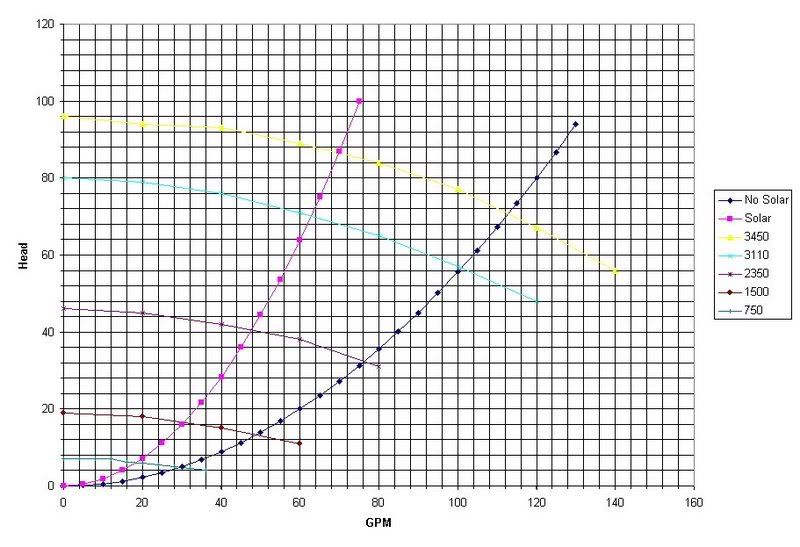
It was probably a good idea to move this thread into the china shop. It was starting to get a bit heavy for the construction forum. Not too many people want to get into the details of hydraulics so I usually give simple approximate answers. But I tend to get a better understanding of rules of thumb by getting into the details. On to the discussion at hand………


Curve Fitting

Taking data off of a picture is bound to generate significant errors depending on who does it and how. However, I went back and looked at the chart again, I enlarged the head graph, placed grids over it and I got closer to 95 GPM so I think we are both reading it differently. Anyway, I have found that printed graphs tend to be somewhat inaccurate as well as difficult to read and I bet if you got the data directly from Pentair in tabular form, you might find it different than what is on the graph.

Static Head

Next, I wanted to more clearly define static head so there is no confusion. The classical definition of static head loss in hydraulics is vertical lift or how far the pump must lift the water in a pipe to a different elevation. This type of head loss is independent of flow rate, depends only on vertical distance traveled and is not related to pumps at all. Dynamic head loss is the opposite where it depends on the velocity of water and the pipe/fitting it is going through.

Also, the pump itself will not have any signicant amount static head loss so to describe the head equation as having a static part and a dynamic part is probably not valid. As far as the pump head curve is concerned, a pump does not care if it is subjected to static or dynamic head, head loss is head loss which is resistance to flow. However, a pump responds to different head loss with varying flow rates which is were the head curve comes from. The way I like to think of it is that the pump causes flow, the flow causes head loss in the plumbing, the head loss causes the flow to slow down in the pump and so on. It is circular but can be solved in closed form or by iteration depending on the head loss curve formula.

Pump Conservation of Energy

As for pumping theory, total energy within the pump system must be conserved where water flow is only one part of the total energy. So even if GPM decreases, it does not mean the total energy does or that it is somehow lost to “leakage”. The motor delivers energy to the shaft as BHP and the impeller then transfers that energy as both pressure and flow. So full energy transfer equations of a pump are:

Motor Formula:
Kwatts (Energy Usage) / .746 = IHP (Input Horsepower)
IHP * Motor Efficiency = BHP (Braking Horsepower)

Pump Formula (exclusive of motor)
BHP * Pumping Efficiency = WHP (Water Horsepower)

Water Horse Power Conversion Formula
WHP * 3960 = Head * GPM

So the total efficiency of a pump is
Total Pump Efficiency = Motor Efficiency * Pumping Efficiency

So as head increases and GPM decrease, WHP would be constant if the pumping efficiency stayed constant. This is the reason I started with this equation to model the head curve. However, pumping efficiency is not constant and is dependent on both flow and head, and it usually peaks near the mid point of the head curve. So GPM is not really “lost” at high head due to "leakage" but it's energy is transfered to pressure or high head such that energy is conserved via Head * GPM. So another way to think about it is those "extra" GPMs are staying in the pump housing and creating more pressure rather than leaving the pump to create flow.

Motor efficiency losses are due to the I^2R losses in the windings, electromagnetic radiation, and friction in the motor. Pumping efficiency losses are due to the friction losses in the pump housing and head losses near the impeller and before exiting the pump housing.

As you have found, motor efficiency is much more difficult to model than pumping efficiency. Few manufactures, if any, will show energy consumption as a function of motor load. As a general rule of thumb, there is a sweet spot for pumps where the pumping efficiency reaches a maximum for a particular head value and the motor efficiency also reaches a maximum for a particular head value which is usually between (75% -100% of load). Too little or too much load and the motor efficiency goes down. A well designed pump will optimize both and together they will give an optimum efficiency over a range of head values.

Just getting data on electric motor energy efficiency is difficult at best. It is usually not published or only noted as peak efficiency. A call to the manufacture may get you the data but I have not been successful to date.

Although it is a noble effort to try and model the pump with great precision, given the uncertainties involved and lack of data, I think a rough approximation of energy savings should be sufficient for economic business case to see if it is worth it. With variable speed pumps, you will get your best energy efficiency at the lowest RPM. However, you need sufficient flow to give you at most two turnovers a day which is only 22 GPM over 24 hours. Using the .03 * RPM formula gives close to 750 RPM for 22 GPM.

I am not sure what electric power curves you are referring to but if you have one for 750 RPM, then you can determine the energy usage in 24 hours and compare it to two turnovers of your existing pump and see the difference. From the data you gave previously, your old pump required 6 hours for 2 turnovers (solar off) @ 950 watts which would be 5.7 kwatts/day.

Here are a few more good papers/sites that I have found which goes over many of the details of pump and plumbing systems.

http://www.pumped101.com/efficiency.pdf
http://www.pacificliquid.com/pumpintro.pdf